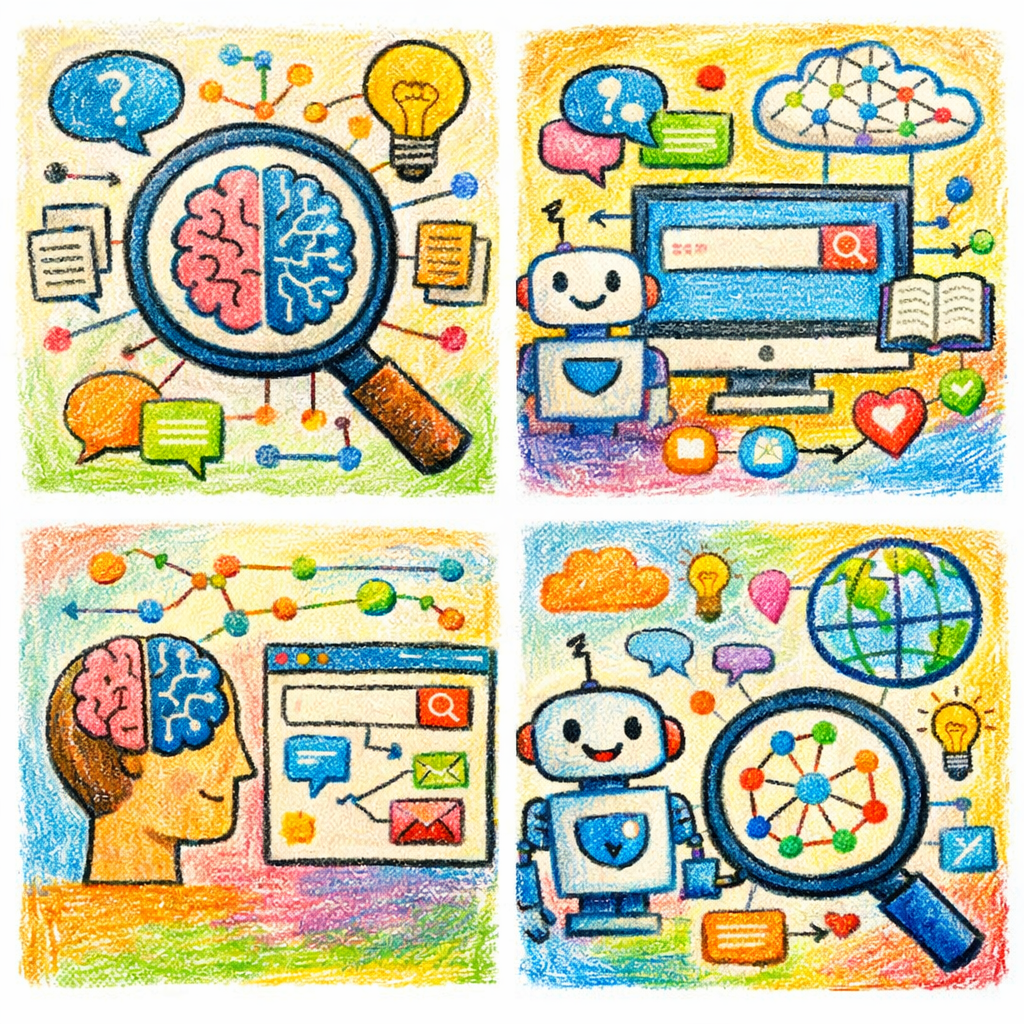
Semantic search is an approach that truly focuses on understanding what users actually mean when typing or saying a query, not just literal words. Modern systems go beyond matching keywords; they analyze language patterns, entities, relationships, and intent for more relevant helpful results. This evolution is being driven mostly by AI technologies such as natural language processing, machine learning, and knowledge graphs.
In practice, semantic search enables search engines like Google and Bing, and AI search tools including newer generative search interfaces, to interpret nuances in user queries such as “top budget smartphones for photography” and return results that best match the intent behind the query, even if the webpage does not contain those exact words.
How Semantic Search Works
Semantic search engines operate in several interlinked stages that are designed to model human understanding of language and meaning.
- Query Understanding
NLP analyzes the user query to determine keywords, phrases, and structure. The objective is to understand not only what was typed but what the user wants.
- Intent Recognition
While a query is made, modern AI models classify it into intents like informational (“how to…”), navigational (“site name”), transactional (“buy”), or local (“near me”). This helps tailor results accordingly.
- Entity Detection
Systems identify entities: people, places, products, concepts; and map their relationships. Examples: In “best lens for Nikon Z6,” entities would be lens and Nikon Z6 combined in context.
- Contextual Matching
Semantic systems use context such as user location, previous queries, and search history to refine the results. For example, “coffee shops” will return nearby cafes rather than generic articles.
- Result Ranking using AI
By using semantic similarity and knowledge graphs, the engine ranks pages, not for keyword matching only, but for meaningful relevance to the intent and entities.
Entities & Context: The Heart of Semantic Search
The building blocks of semantic understanding are entities. Unlike keywords, entities are defined in the real world and have an identity. Consider Apple, the company, versus apple, the fruit. Semantic systems tell them apart through context. This is how ambiguity is avoided and contextually appropriate answers are given.
Contextual signals matter, too. Included among them are:
- Location data including local service results.
- Previous questions and session behavior, to understand follow-ups.
- Device and time context: mobile versus desktop, time of day.
Put together, entities + context enable search systems to understand a query the way a human would, leading to better answers and far fewer irrelevant results.
Examples in the Real World
- Search Engines:
The semantic understanding at scale is powered by Google’s Knowledge Graph, BERT, and MUM. These are AI components that help decipher complex queries and even generate concise answers directly into results. - Voice and Conversational Search:
With Bing Chat, for example, Google Assistant, and AI-driven bots, natural language conversations are comprehended. You can ask multi-step questions like “find Italian restaurants open now with outdoor seating,” and they’ll interpret each part correctly. - E-commerce search:
Semantic search allows the product sites to understand the intent of the users, such as “comfortable office chair under $200 with lumbar support,” returning results that match attributes even if the product names do not include those exact terms.
Optimization Checklist: SEO & AI Search
For ranking well in this new era of semantic AI search, content strategy has to evolve past keyword stuffing. Here’s a practical checklist for modern semantic optimization:
- Focus on Search Intent
Informational, commercial, and transactional user intents include creating content that answers why, what, and how as explicitly as possible.
- Use Related Terms and Synonyms
Implement LSI terms and semantically related keywords; these help search engines understand topical depth without keyword repetition.
- Clearly Define Entities
Use schema markup to clearly tag your products, people, places, and concepts.
- Topical Depth Over Keywords
Cover the topics comprehensively, with subtopics logically interlinking to ensure relevance for related queries.
- Answer User Questions
Provide FAQ and conversational content formats that follow the question phrasing of natural language.
- Optimize for Voice & Conversational AI
Use natural phrasing and complete sentences. Think about how one speaks, not just types.
- Utilize Concepts of Knowledge Graphs
Use entities within your content and link to authoritative sources where appropriate.
- Localize When Appropriate
Include location-based context in local queries to increase the relevance and visibility in local search.
The Future is Semantic
AI-driven semantic search is not a technical enhancement; it’s more of a paradigm shift in how search engines think and serve users. Intent, context, and entities are prioritized in modern searches for smarter, highly relevant results. To the SEO professional and content creator, embracing semantic principles is no longer optional; it’s a must for 2025 and beyond visibility and ranking.
FAQs
1. What is semantic search in SEO?
Semantic search in SEO refers to how search engines understand the meaning behind a query, not just exact keywords. It uses AI, NLP, and entity recognition to match content with user intent and context, improving result relevance.
2. How does AI improve semantic search?
AI improves semantic search by analyzing:
- Natural language patterns
- User behavior signals
- Relationships between entities
Machine learning models like BERT and MUM allow search engines to interpret complex queries, synonyms, and conversational language more accurately.
3. What are entities in semantic search?
Entities are clearly defined concepts such as people, brands, locations, products, or ideas. Search engines connect entities through knowledge graphs to understand context, for example, distinguishing Apple the company from apple the fruit.
4. What is search intent and why is it important?
Search intent is the goal behind a user’s query. It typically falls into four categories:
- Informational
- Navigational
- Commercial
- Transactional
Semantic search AI prioritizes content that best satisfies the detected intent, not just keyword presence.
5. How do AI search engines differ from traditional search engines?
Traditional search engines relied heavily on keyword matching. AI search engines use:
- Semantic similarity
- Contextual understanding
- Entity relationships
This allows them to return more accurate answers, even when queries are vague or conversational.
6. How can I optimize content for semantic search?
To optimize for semantic search:
- Write for topics, not just keywords
- Include related concepts and entities naturally
- Match content to search intent
- Use structured data (schema markup)
- Answer common user questions clearly
This helps search engines understand your content holistically.
7. Is semantic search important for voice search and AI overviews?
Yes. Semantic search is the foundation of voice search and AI-generated answers. Voice assistants and AI overviews rely on intent detection and contextual understanding to provide concise, accurate responses.